Start with the garment’s situation
Three paths connect restyling, repair and repurposing to the piece in front of the user.
Why this decision?
A useful next step depends on the condition and possibility of that garment.
Fashion sustainability · Native iOS
More possibilities in the clothes you already own.
A native iPhone project helping people restyle, repair and repurpose existing clothes through guided actions and outfit-compatibility recommendations.
Explore the story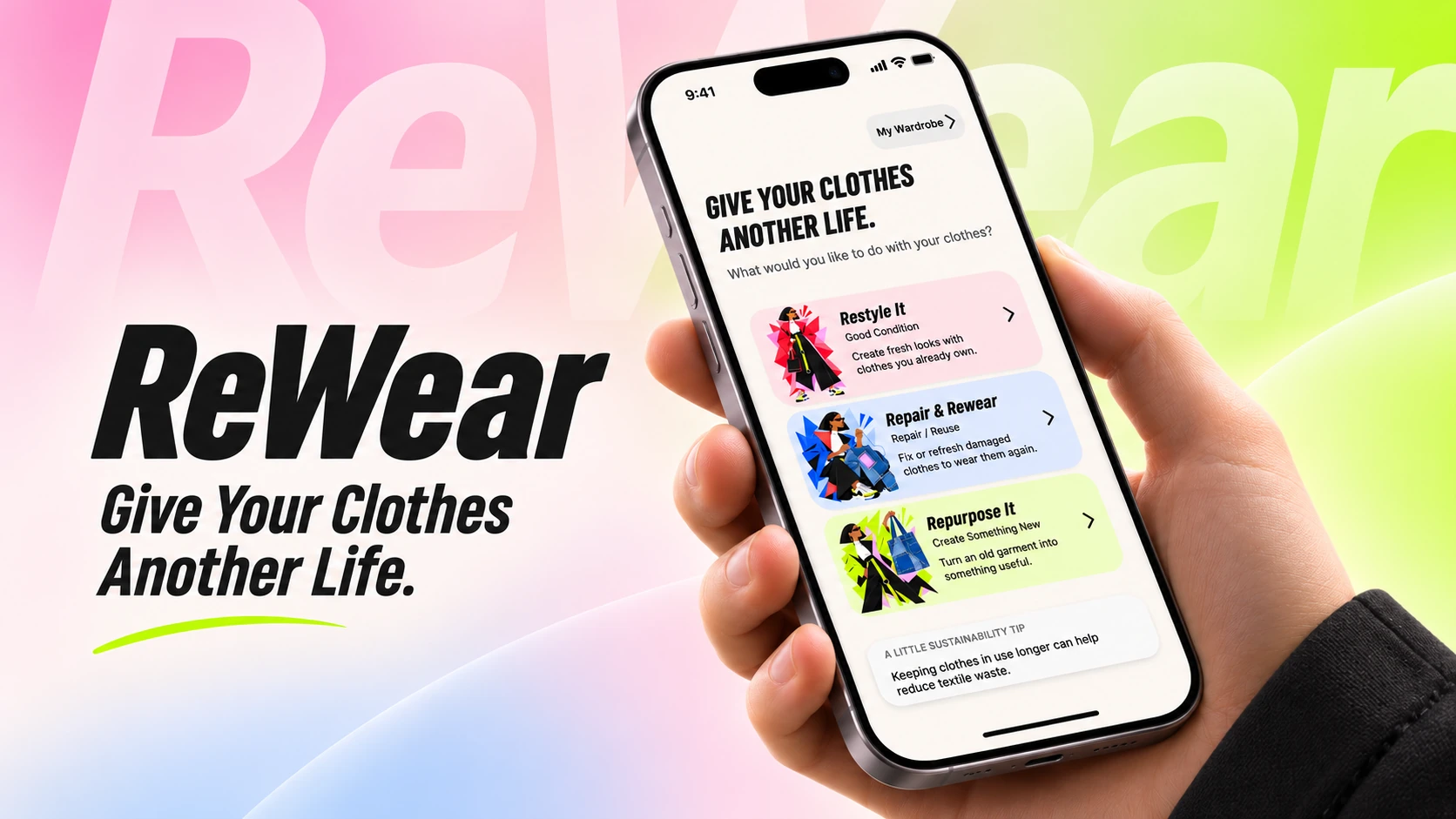 Native iPhone app
The problem, contribution, key decisions and experience. Switch to Full story for more detail.
Design system · Visual identity · UX/UI
Native iPhone app
Fashion sustainability · Native iOS
Apple Developer Academy · Team project
THE STORY IN 30 SECONDS
MY CONTRIBUTION
Within a five-person team, I focused on the design system, signature character and illustration direction, and the experience and interface design. Research and engineering were shared team work.
THE PROBLEM
Clothes can remain unused even when a wardrobe is full. ReWear turns the sustainability question into practical possibilities for the garments someone already owns.
How might we make extending the life of existing clothes an achievable everyday action?
RESEARCH & FRAMING
The team’s survey included 59 participants. 72.9% reported often or almost always feeling they had many clothes but nothing to wear. This informed three paths: Restyle It, Repair & Rewear and Repurpose It.
THE SYSTEM
The team project connects garment context, guided activities and a wardrobe. The presentation documents Swift/SwiftUI and an adapted pretrained OCMCF model for on-device Core ML outfit compatibility.
BEFORE THE SOLUTION
Research synthesis
Three-path experience
Design system & character
Native iPhone implementation
KEY PRODUCT DECISIONS
Three paths connect restyling, repair and repurposing to the piece in front of the user.
A useful next step depends on the condition and possibility of that garment.
Guides, checkpoints and completion states structure the activity.
A practical sequence helps turn a broad intention into something someone can try.
The signature character appears across activities with a consistent visual identity.
Reusable visual language makes different paths feel like one product.
Wardrobe and ownership confirmation are part of the journey.
The opportunity starts with what the person already has.
VISUAL DIRECTION
A bold character system carries one recognizable identity across styling, repair and repurposing. SF Pro supports interface reading; Barlow Condensed gives short editorial lines their energy. Four expressive colors connect the illustrations and reusable UI components.
PRODUCT EXPERIENCE
EXPLORE THE ORIGINAL DESIGN
Interactive design walkthrough · Prototype data
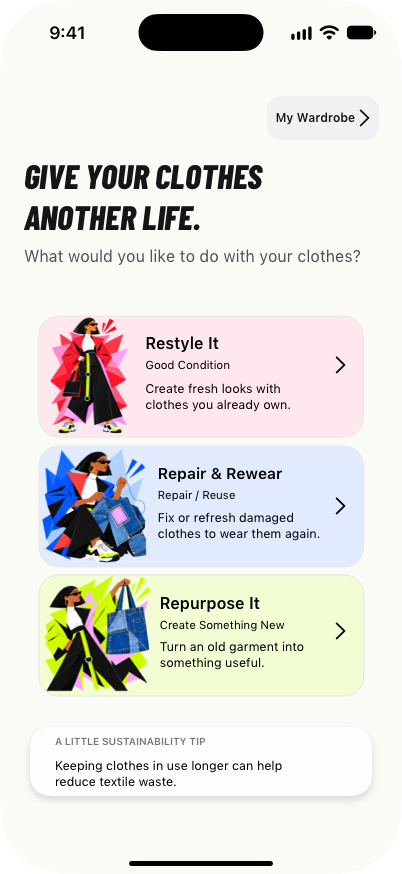
Restyle, repair or repurpose an existing piece.
Confirm ownership and keep the garment in the experience.
Work through the selected activity and its checkpoints.
Finish the activity and return to more possibilities.
Start with a garment and a possibility: restyle it, mend it or give it a new purpose.
Select a screen to view it larger.
Ownership, wardrobe feedback and damage selection make the next step explicit.
Select a screen to view it larger.
The repair guide and completion states help carry an intention into action.
Select a screen to view it larger.
Original illustrations and graphic assets show how the character and design system extend across activities.
Select a screen to view it larger.
OUTCOMES & REFLECTION
A team-built native iPhone project at Apple Developer Academy
A documented design system and reusable signature-character library
Connected restyling, repair and repurposing flows
The next questions are recommendation relevance, guide clarity and whether people return to their existing garments. No measured reduction in clothing waste is claimed.